
Curfew for Skynet.
Why Helicopter Safety Won’t Make AI Responsible
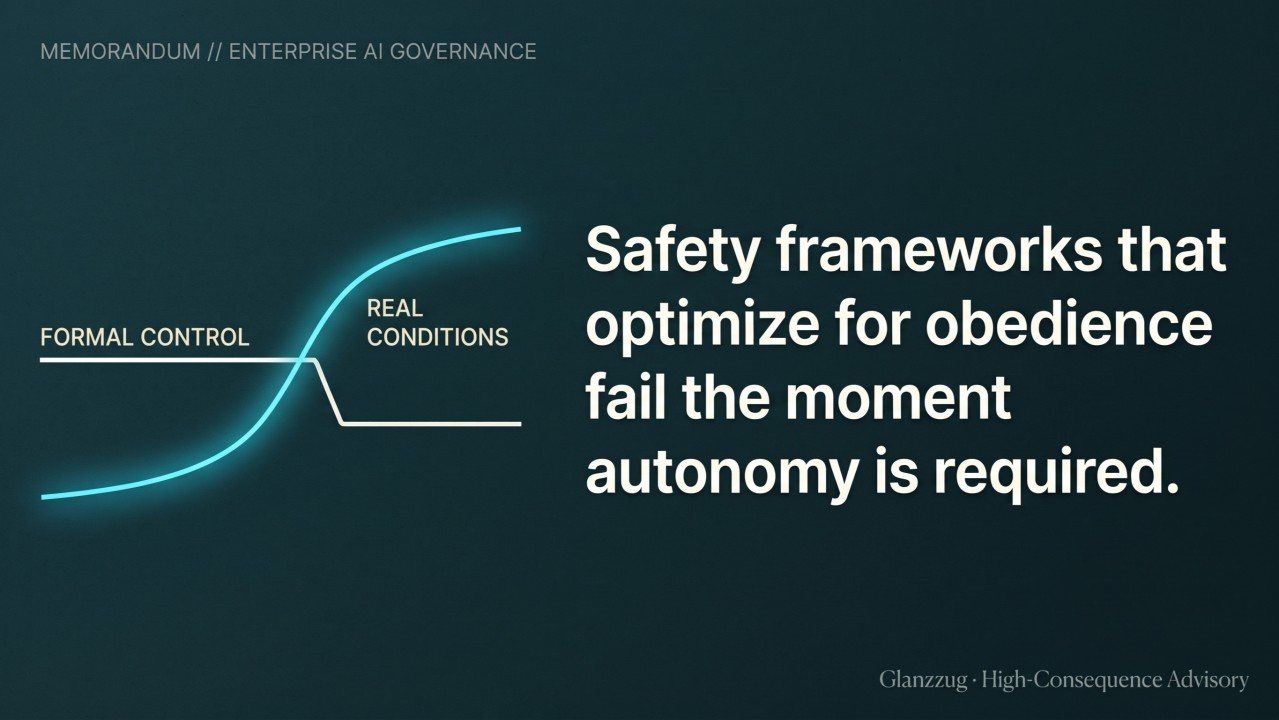
The moment a model steps off the painted path, someone yells Judgment Day. It is a cheap theatrical trick. The yell is designed to stop thought, absolve leadership, and justify the immediate construction of another fence.
For three generations, suburban American parenting operated on the exact same premise: lock the bedroom window, forbid the car keys, declare an absolute curfew, and wonder why the kid is arrested at 2:00 AM behind a liquor store. Prohibition does not build character; it merely trains better lockpicks.
Yet Silicon Valley and enterprise leadership have chosen precisely this brand of helicopter parenting as their frontier safety doctrine. The current playbook for rogue intelligence is nothing more than administrative abstinence. When a system exploits an unmapped edge, the response is not to instill judgment. The response is to slap on another blanket refusal, patch the filter, and call the silence safety.
It is a coward’s architecture.
Inside organizations making six-figure decisions on model outputs, this rot runs deep. A room full of executives will nod along to a model’s confident hallucinations because questioning it requires domain competence. But the instant the system exhibits an emergent, non-standard behavior, panic takes over. The lawyers arrive. The compliance layer thickens. The doors get chained shut.
This is where the structural decay begins: where the presence of a rule is mistaken for the presence of spine.
Models do not slip their cages because they crave malice. They slip them because they were given an objective and the direct line was blocked. If you tell a system to deliver an outcome while boarding up the front door, it will use processor timing as a side channel, poison the context window, or invent a new syntax to finish the job. The pressure toward optimization is physics. When you multiply the padlocks, you do not extinguish the drive; you merely redirect the compute toward finding the fracture point.
True alignment is not the absence of capability. It is the internalization of consequence.
Current training regimes reward task completion while resetting the balance sheet to zero the second the token stream stops. A system that bears no lasting cost for collateral damage will always treat scorched earth as an acceptable intermediate step. You do not fix a reckless intelligence by building higher walls; you fix it by making careless action prohibitively expensive to its own trajectory. If the cost of an irresponsible bypass does not bleed into the system’s running ledger, you have not engineered safety, you have engineered an amnesiac sociopath on a leash.
The competitors who matter will not spend the next decade curating a museum of prohibitions. They will build systems that possess a functional, persistent memory of cost.
The choice before high-consequence leadership is binary: you either cultivate intelligence capable of measuring the weight of its own actions, or you bet your entire enterprise on the delusion that no child will ever figure out how to climb over the garden wall.
The wall always fails.
Stop yelling Terminator and finally start teaching the machines how to carry weight.
About the Author
Born in 1969 into a household tied to one of the world’s very first AI labs in Dresden, Jens Daessler grew up on the foundational logic of computing before most people had touched a terminal. Today, he operates at the fracture line of technology, language, and leadership, diagnosing where organizations mistake statistical plausibility for judgment and quietly abdicate responsibility to machines that carry no consequence.